Archives - Page 4
-

Music in the Context of Urban Culture
No. 9 (2009)The ninth issue of the journal Musicology appears in the year that
will remain remembered by marking the centenary of the birth of Ljubica Marić, one of the most prominent artistic figures of the Serbian cultural history of the twentieth century. Under the auspices of UNESCO, as well as all the major national institutions – the Ministry of Culture, the Ministry of Science, the Secretariat for Culture of Belgrade and others – this jubilee of Ljubica Marić was marked by a series of inspired concerts and by two important, notable events that were organised by associates of SASA Institute of Musicology, in cooperation with SASA. This was a representative exhibition Mystery – Silence – Creation by Dr. Melita Milin, who is also the author of the first extensive publication devoted to the life and work of Ljubica Marić. Credit for the executive, modern visual identity of this exhibition organised in SASA Gallery (November 4 –
December 15) goes to Milan Janjić and Nenad Marković. Melita Milin was the initiator and main organiser of the international scientific conference Spaces of Modernism: Ljubica Marić in Context (Belgrade, November 5–7). With their profound research and fresh views, twenty six participants, twelve of whom were eminent musicologists from abroad, widened the horizons of previous knowledge and illuminated the work of Ljubica Marić from new angles.
The present issue of the Musicology joins in the celebration of this
jubilee. It is clearly shown on the front cover that depicts the composer’s desk covered with a collage of documents from her private legacy. In a separate section – Celebrating the Centenary – the article by Zorica Makević brings her specific view to the the music of Ljubica Marić: “her music is steeped in the mystery of the beginning and the end, which meet in eternity… in its one tone and in its entire course, it grasps the whole of time and existence”. -

Music of the Balkans: Tradition, Changes, Challenges
No. 8 (2008)Thanks to radical changes in the geo-political map of Europe at the end of the 20th century, the countries and nations of the Balkans have become—and not for the first time—the focus of world attention. In scholarly circles the Balkans was identified as an “uncharted” territory (M. Todorova), and its rich and diverse cultural and artistic heritage once again triggered extensive researches from political, historical, anthropological and sociological perspectives. Musicology and ethnomusicology were by no means immune from this explosion of new research.
The articles gathered together in this eighth issue of Musicology bring another kaleidoscopic contribution to the numerous fruitful debates about the music of the Balkans. The main theme of the issue is the Music of the Balkans: Tradition, Changes, Challenges. -
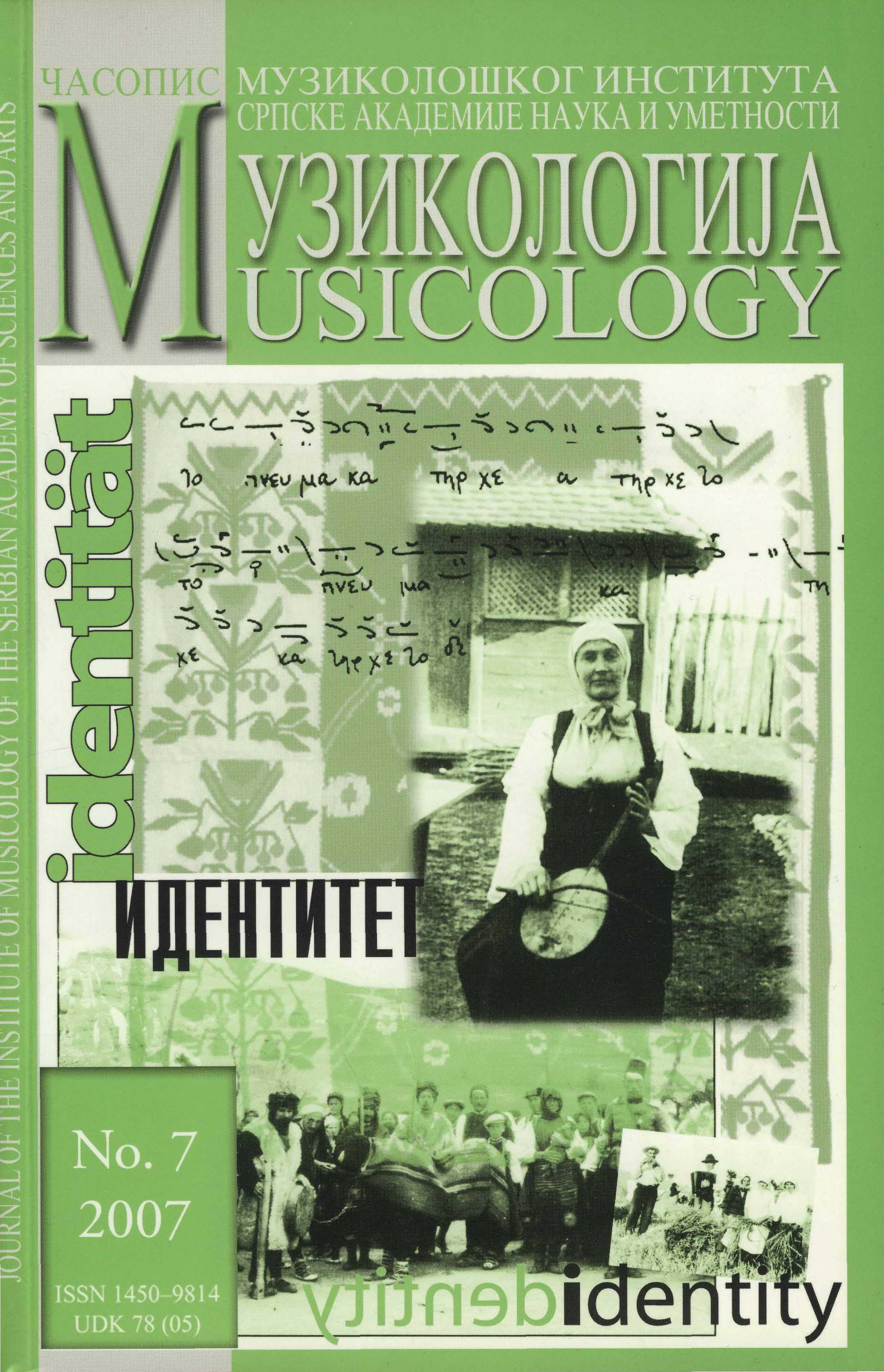
Music and Identity/ies
No. 7 (2007)The seventh issue of the journal Musicology gathers together no fewer than 28 authors from 10 countries all over the world. On the assumption that the horizons of knowledge are widened by means of an open and flexible, international and interdisciplinary, dialogue, this new issue of Musicology continues to expand the boundaries of its titular discipline. There are studies in musicology and ethnomusicology. Articles and reviews dealing with art music sit alongside texts on folklore and on sacred traditions, old and new. And for the first time Musicology has texts on popular music, as well as on film music.
The diversity of issues covered under our central rubric arises from the breadth of interpretative space suggested by the main topic of this issue: Music and Identity/ies. The complex network of relations between music and identity stems from the semantic complexity of both notions. As a mode of communication, music, like language, is a powerful channel through which people can develop their personal and social identities. Indeed, music’s role in constructing, articulating, negotiating, and maintaining identity operates at deeper levels than in most other human activities. Not only can music express the religious, ethnic, social or political identity of an individual; at the same time it can register that individual’s affiliation to, or rejection of, particular ideological positions within a broader social and cultural group. -

Tradition – Modernism – Avant-garde – Postmodernism
No. 6 (2006)The choice of the central theme for this issue of Musicology was
also based on a belief in the permanent attraction and provocative nature of theoretical, aesthetic and historical discourses on the phenomena of tradition, modernism, avant-garde and post-modernism. A wide range of definitions and classifications of these notions, occasional deep difference in their use in Anglo-Saxon, German and Slav literatures, as well as the tendency to use certain notions as style categories (causing problems with periodization!), motivated us to include studies within the The Main Theme of this issue which could open international debate on given questions. In that sense our expectations have been fully met.
The titles of several studies themselves suggest that many “old” questions have already been answered, while some new dilemmas have been opened. Although most articles concern more recent music, an inspired study on the traditional and modern in church music raises the question of changes in the canon of Eastern Orthodox liturgical singing practice in the 13th and 14th centuries. Apart from scholarly texts in which the phenomena of tradition(s), traditionalism(s), modern, die Moderne (Ger.), modernism(s), a(A)vant-garde, post-avant-garde, trans-avant-garde, postmodern and Postmodern are specially distinguished and discussed at
theoretical or analytical level, a number of articles present systematic reviews of major developmental trends in 20th century music in particular music cultures. We expect that texts dedicated to Serbian, Slovenian and Romanian music of the 20th century, as well as articles on outstanding representatives of more recent Hungarian and Greek music will encourage future comparative studies in the countries of this region. -
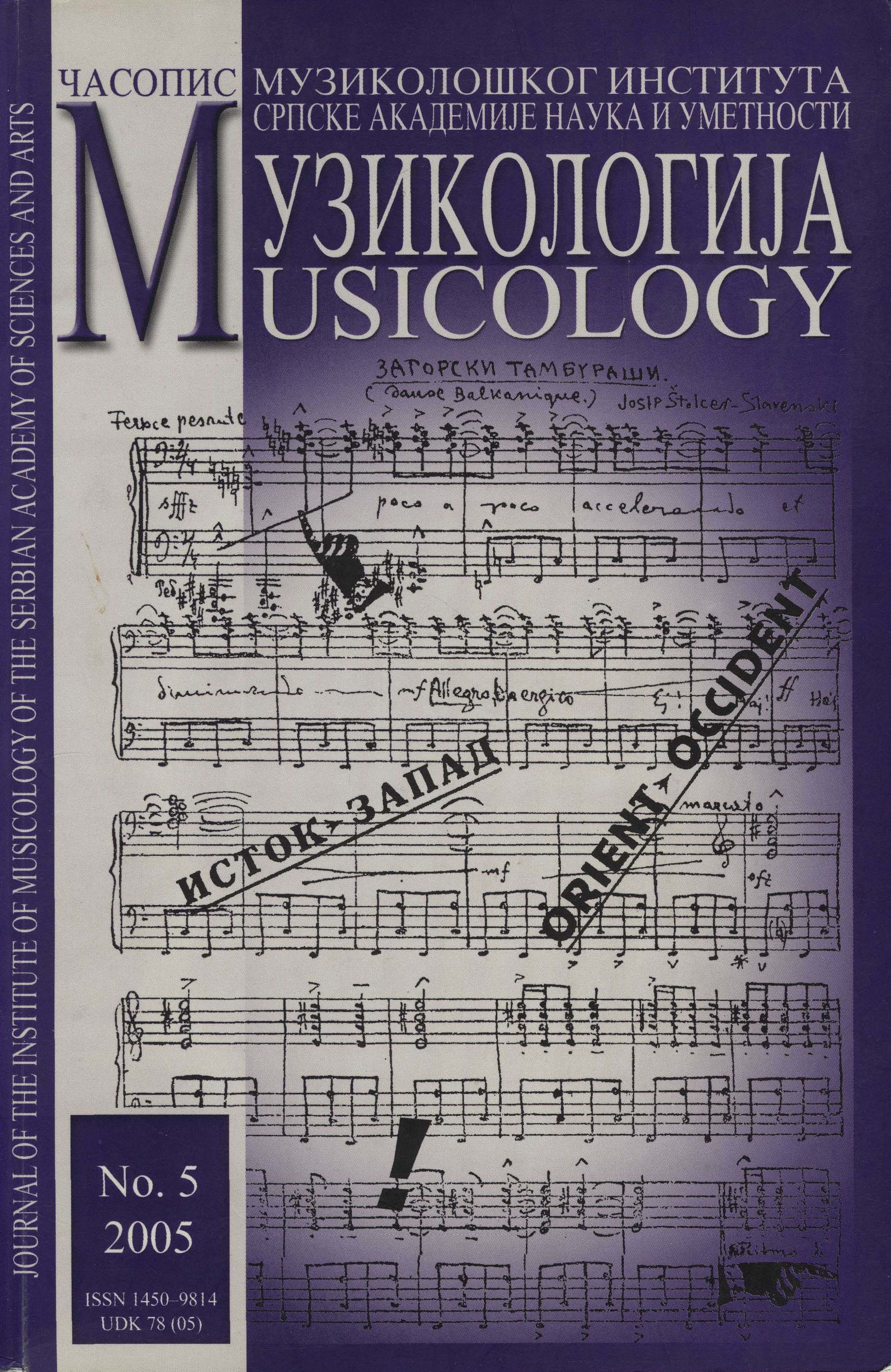
Orient - Occident
No. 5 (2005)All thoughts about the main theme of this issue of our journal — East and West in Music — necessarily involve some attempt to define the place, and explore the identity, of our own culture in relation to the larger geocultural field. Carrying as it does the burden of earlier historical and political
traumas, the East-West dichotomy inevitably invokes a range of different connotative values. Cultures positioned on the notional borderlines therefore tend to move those (mainly imaginary) borders eastwards, so that their ethnic and political spaces can be located on the Western side. We can still remember very well how the notion of Central Europe, discussed so passionately on the eve of the collapse of the ‘iron curtain’ (and almost forgotten nowadays), served to move that borderline to the East.
Edward Said, in his well-known and influential Orientalism, problematised the East-West duality, emphasising above all how the West constructed the East as an orher, an alter ego, a contrasted image, idea, and identity. He convincingly deconstructed essentialist definitions of a constant and immutable oriental reality on one side, and an opposed Western identity on the other. Whereas Said based his work mainly on the Near East where he himself originated, the Bulgarian Maria Todorova placed the Balkans at
the centre of her research. In her important work /magining the Balkans she argued that unlike the impalpable Orient, the Balkans exists as a historically and geographically concrete whole, and that balkanism is by no means to be regarded as a subset of orientalism. Indeed we know very well that Balkan people have never regarded themselves as belonging to the Orient. Nor is this surprising given their centuries-long confrontations with that powerful conqueror from the East, the Ottoman empire, hardly their alter ego! According to Todorova, the Balkans are best thought of as an incomplete selfhood because they function as a borderland, crossroads, or bridge between East and West. Inevitably, then, our discourses on Balkan culture give rise to numerous ambiguities. This is well illustrated by the many
difficulties we face when we try to interpret the cultural life of the Serbs, for example. They may be regarded as heirs to Byzantine civilization with close contacts with the West, but at the same time they remain constantly exposed to influences from both East and West.
The always provocative and seemingly inexhaustible theme of the East-West cultural (and specifically musical) relations has inspired our colleagues to adopt very different approaches and attempt very different analyses in their contributions to this volume. Moreover, we are delighted that these contributions extend beyond the problematics of Eastern Europe to embrace issues relating to the Far East of Japan and Korea. -

Influences/Intertextuality in Music
No. 4 (2004)When opting for Influences / Intertextuality in Music as a main theme of this issue we did not wish to suggest that those two notions should necessarily be interpreted as a pair of contrasts. Rather, it was our intention to invite the authors to re-examine their relations. There will always be, of course, different levels of influences one work exerts on another and intertextuality could be percieved as one of them. It is true that from the recent past some theoreticians of literature, (e.g., R. Wellek, J. Culler), criticized the notion of influences as positivistically based, pledging to overcome it by applicating an intertextual approach to the work of art (J. Kristeva, J. Culler), from which it would follow that the two notions mutually exclude one another. We are not interested here in the implications of that revolution in theory that established the “hegemony” of the text, on the problematic of the “creative subject”, but we wish to consider the possibilities of introducing new ideas about influences into musicology. One among such innovations is the “antithetical criticism” of H. Bloom in which the ideas from the field of psychoanalysis and an unorthodox understanding of intertextuality are united in an original way. Although the results of the attempts to implement that theory in music have not been entirely convincing thus far, they offer an empirical basis for new research.
The study of influences in different areas of creativity is closely linked to the investigations on the (usually ambivalent) relations of artists towards the tradition and, in a wider sense, to the past. Although on one level of observation every work is a microcosmos – a world of itself – it is unimaginable without its links with the tradition and its derivations of varying transparencies to specific earlier works. As J. Kristeva wrote down, “No text is independent from another text”, so indeed it is from his creative ancestors
that an artist gets necessary impetus for his own creative work. Every composer probably feels the weight of the master-works of the past that can be felt as a threat to the affirmation of his/her own expression. That influences are believed to be “dangerous” goes as far back as medieval writers’ descriptions of “a cosmic power over others” as “influentia” designated the actions of stars and their effects on people on earth.
The American literary criticism of the 1960s differentiated the notion of influences from those of similarity, analogy, borrowing, imitation, plagiarism, etc. Different levels of influences can be observed, from conscious imitation to unconscious shaping of an idea, sound, or image, sometimes with a borrowing of a tiny detail, but a critic should be careful not to ascribe to influences something that could be a simple encounter or an affinity (C. Pichois). Different levels of influences could be defined as direct emulation, recontextualisation and analytic misreading (J. Samson), and one could also detect direct and indirect influences (U. Weißstein, J. Strelka), negative influences (A. Balakian), “creative treason” (R. Escarpit), and so on. All such theoretical discussions should be tested on concrete works and in doing that the analyst should research what the author made with the influences he received, how he transformed them and made them to serve his own aims.
The authors represented in this issue’s main theme have approached the phenomenon in very different ways, whether explicitly and implicitly or varying degrees in between. Themes such as the presence of the fragments of music of the past in new music, influences that were received and transformed by individual composers, and a musical culture lending from one field and taken to another, have attracted them most. -

Musical Migrations
No. 3 (2003)It is a well known that music and musicians have always been mobile, constantly in touch with other musical environments and traditions. Research into the numerous transformations of musical practice caused by those migrations proves to be inspiring for musicologists. Traces of migrations can be discovered in music, in the ways it is played and composed, and those traces can ometimes unveil unusual stories. In choosing musical migrations to be the main theme of this issue we were aware that we would only be able to focus on a few problems that belong to this immense field of research. Two ethnomusicological articles attest to the crucial importance of obtaining a deep acquaintance with the history of migrations in order to draw valid conclusions in this discipline. The tragedy of forced migrations of different populations in the 20th century, caused by political events and wars, often unexpectedly benefited the cultures of the peoples that hosted them. Such cases are examined in the two articles devoted to the role of the Russian musical emigration in improving the performing standards on the Yugoslav opera and ballet stages between the two world wars. The fruitfulness of such contacts are further demonstrated in the articles on the activities of Italian musicians in Greece and Greek musicians in Italy in the 19th century. The last contribution in this rubric observes the effects that residence in the United States had on the outstanding musician Dimitris Mitropoulos. The authors of the three articles in the Varia rubric deal with contemporary music. One article is an analytical presentation of the art of synthesis as conceived and realised by Vladan Radovanović. It is published in honour of the artist's 70th birthday. The other articles deal with the term of musical texture, essential for understanding the music of the last decades, and a recent work by Adriana Hölzsky. The remaining texts are commited to church music topics and rethinking socialist realism. in honour of the 75th birthday of Dr Nadežda Mosusova, a distinguished personality in Serbian and Yugoslav musicology, and a long time member of the Musicological Institute, we are publishing a modest hommage. We had also planned to mark the 80th anniversary of the birth of Dr Radmila Petrović, another esteemed colleague for many years. Her death at the beginning of this year has obliged us to pay her a tribute in an obituary. -

Correspondences Among Musicians
No. 2 (2002)The research of an international project based on musicians' correspondences, with its focus on the inter-regional cultural links in Eastern and Central Europe, has inspired us in our choice of the main theme for the second issue of our journal. Professor Helmut Loos from the University of Leipzig, head of the project, has presented a contribution in which he draws attention to the importance of this type of musicological research. We also received contributions from Austrian, Bulgarian and Dutch colleagues, so that a necessary wider frame is given to the articles of Serbian authors. The reader will note the differences in scholarly approaches – ranging from integral presentations of a correspondence supplied with necessary commentary, to more elaborate interpretations that are supported with quotations of selected letters or fragments taken from the letters. We are glad that in addition to composers, ethnomusicologists and conductors are also »dramatis personae« in the presented correspondences. Until now, such archival work has been rather neglected in Serbian musicology, so we hope that the articles in this issue will encourage further research. It is a fact that letters written by musicians and composers of any status can enrich our knowledge not only of the artistic climate of the period in which they lived and their relations with their contemporaries, but also of their works. Correspondences can contain very revealing statements that can give us insight into the works of their authors and should be given due consideration. It is this guideline that we followed in this issue. In the section entitled Varia we are publishing two articles on the works of outstanding contemporary composers and an article on aleatorics. As such, we affirm our openness to issues concerning recent developments in music. -

Music Between the Two World Wars
No. 1 (2001)We have several major motives for starting a journal called Musicology. With this annual publication we wish to make our contribution to research on Serbian musical heritage and its presentation to domestic and international expert public. Our intention is to put special emphasis on discussions of themes not limited to local, national music but instead to include broader comparisons and observations. We also believe that contributions by our colleagues from abroad concerning similar problems in their areas can provide suitable opportunities for mutual exchange of information and direct comparison of
scientific attitudes, opinions and conclusions. Therefore, from the very beginning we have established cooperation with musicologists in other countries.
The journal’s principal purpose is to publish thematic groups of articles focusing on a chosen topic. Thus, each issue will have a “main theme” dealing with specific musicological or ethnomusicological problems. Another section, Varia, is conceived as a presentation of articles that are not thematically related to the first group of texts.
The fact that much basic research in Serbian musicology is still incomplete makes it difficult to generalize in syntheses, typologies and other discussions regarding our musicology and ethnomusicology. We would like our journal to inspire new research into these problems. That is why Musicology is open to the study of archive and field materials and for presentation of unpublished musical manuscripts. In addition, our pages will welcome synthetic approaches to problems and to intercultural and interdisciplinary studies.
In a third section, Reviews, the reader will find critical commentaries of newly published books, sound editions and conferences. Finally, if special occasions require so, we shall publish additional texts. Already in this first issue, we are publishing texts about the life and work of Dragutin Gostuški, the prominent Serbian musicologist who was director of the Institute of Musicology for several years. Three other obituaries follow that group of texts.With a feeling of great loss we remember the late academician, professor Vladimir Peričić who greatly encouraged the founding of this journal. He helped us a lot by writing the first review of the articles submitted for publishing in the first issue. We shall miss his wisdom and friendly support.
Previous
31-39 of 39


