No. 5 (2005): Orient - Occident
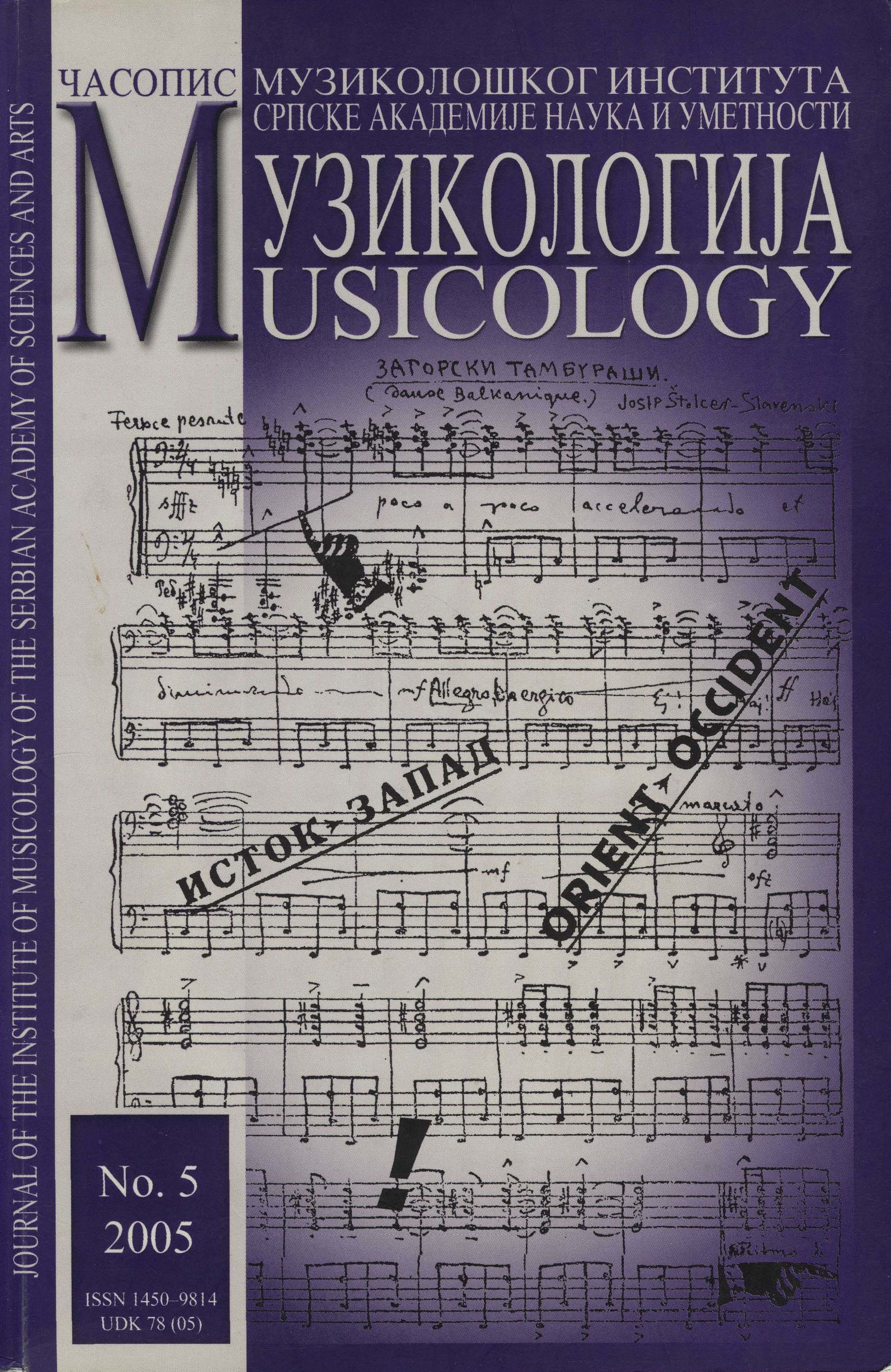
All thoughts about the main theme of this issue of our journal — East and West in Music — necessarily involve some attempt to define the place, and explore the identity, of our own culture in relation to the larger geocultural field. Carrying as it does the burden of earlier historical and political
traumas, the East-West dichotomy inevitably invokes a range of different connotative values. Cultures positioned on the notional borderlines therefore tend to move those (mainly imaginary) borders eastwards, so that their ethnic and political spaces can be located on the Western side. We can still remember very well how the notion of Central Europe, discussed so passionately on the eve of the collapse of the ‘iron curtain’ (and almost forgotten nowadays), served to move that borderline to the East.
Edward Said, in his well-known and influential Orientalism, problematised the East-West duality, emphasising above all how the West constructed the East as an orher, an alter ego, a contrasted image, idea, and identity. He convincingly deconstructed essentialist definitions of a constant and immutable oriental reality on one side, and an opposed Western identity on the other. Whereas Said based his work mainly on the Near East where he himself originated, the Bulgarian Maria Todorova placed the Balkans at
the centre of her research. In her important work /magining the Balkans she argued that unlike the impalpable Orient, the Balkans exists as a historically and geographically concrete whole, and that balkanism is by no means to be regarded as a subset of orientalism. Indeed we know very well that Balkan people have never regarded themselves as belonging to the Orient. Nor is this surprising given their centuries-long confrontations with that powerful conqueror from the East, the Ottoman empire, hardly their alter ego! According to Todorova, the Balkans are best thought of as an incomplete selfhood because they function as a borderland, crossroads, or bridge between East and West. Inevitably, then, our discourses on Balkan culture give rise to numerous ambiguities. This is well illustrated by the many
difficulties we face when we try to interpret the cultural life of the Serbs, for example. They may be regarded as heirs to Byzantine civilization with close contacts with the West, but at the same time they remain constantly exposed to influences from both East and West.
The always provocative and seemingly inexhaustible theme of the East-West cultural (and specifically musical) relations has inspired our colleagues to adopt very different approaches and attempt very different analyses in their contributions to this volume. Moreover, we are delighted that these contributions extend beyond the problematics of Eastern Europe to embrace issues relating to the Far East of Japan and Korea.
Published:
31.12.2005


